North Georgia Manufacturing IT: Plant Capability Checklist
The IT and cybersecurity capability checklist North Georgia manufacturers should hold their MSP against — for Dalton plants and the I-75 corridor.
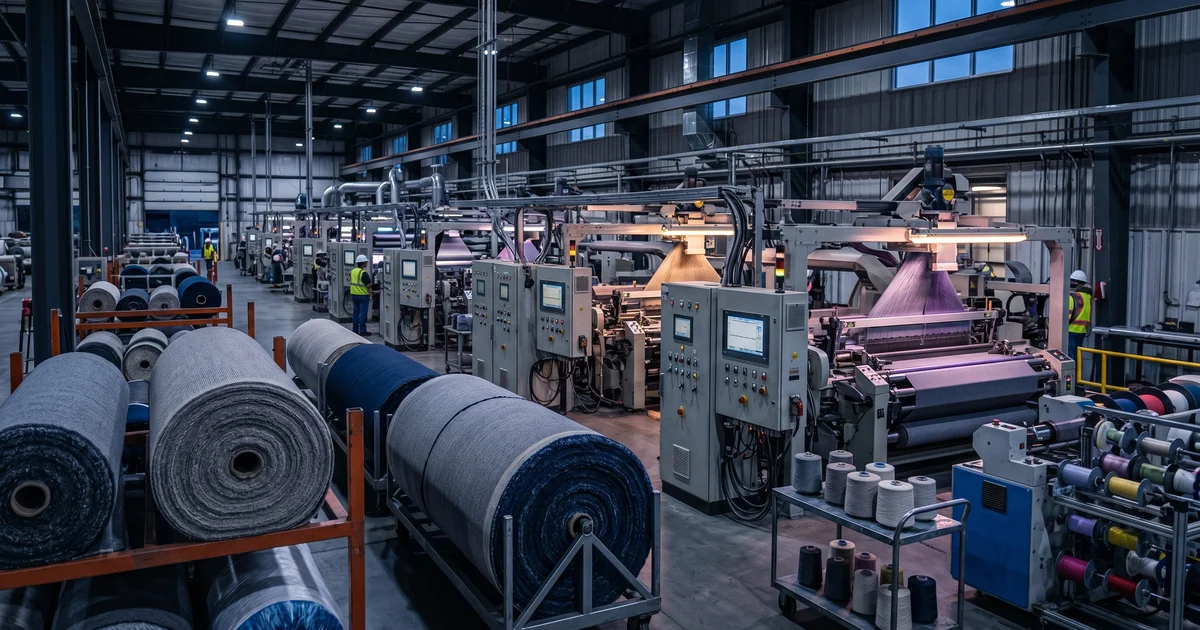
Sixty-seven percent of manufacturing companies have experienced a ransomware incident in the past three years. The number includes some of the largest names in the industry. It includes plants in Dalton — Whitfield County is the carpet and flooring capital of the world, home to Shaw Industries’ $6 billion-revenue headquarters, Mohawk’s flagship operations, Engineered Floors, Beaulieu, and a long tail of mid-market manufacturers whose names don’t make the headlines when they get hit. NW Georgia manufacturing is a national-scale industrial cluster, and the IT and cybersecurity model required to protect it does not look like the model that protects a 50-person professional services firm in Atlanta.
This is the deeper read on what IT for North Georgia manufacturing actually requires in 2026 — for flooring and textile producers in Whitfield County, for distribution and finishing operations along the I-75 corridor through Catoosa, for raw-material processors in Murray and Gordon, for the multi-site businesses that span all of them. It pairs with our regional anchor on North Georgia IT services and the broader threat-landscape context in our cyber insurance EDR requirements post.
Key Takeaways
- OT/IT convergence is the dominant 2026 risk. Production-floor systems are no longer isolated; the attack surface between business IT and operational technology is where most plant breaches actually happen.
- The Dalton flooring concentration is a named target. Ransomware groups specifically pursue manufacturing with high production-stoppage leverage. Carpet, flooring, and textile operators face elevated risk because operators will pay to restart a $5M-per-day extrusion line.
- Multi-site IT works only when management is centralized and response is distributed. One Entra ID tenant + one EDR console + on-the-ground partners in each county.
- Single-shift operations still need 24/7 monitoring. Not for shift coverage — for ransomware detection while attackers do their work on Friday night and Saturday.
- NW Georgia’s BCDR profile is ice storms and tornadoes, not hurricanes. Backup-power sizing, multi-week site-loss planning, and tested recovery procedures all change accordingly.
Why North Georgia Manufacturing IT Is Different
NW Georgia’s manufacturing economy is concentrated in a way most IT vendors don’t appreciate. Whitfield County alone produces an estimated 90% of the world’s carpet supply. The named operators (Shaw, Mohawk, Engineered Floors, Beaulieu, Kraus) anchor a supply chain of mid-market dyers, finishers, backing producers, raw-material processors, and logistics operators that together employ tens of thousands of people across five contiguous counties — Whitfield, Catoosa, Murray, Gordon, and Walker.
That concentration creates four IT realities that don’t apply uniformly elsewhere:
- Multi-site footprint inside a small geographic area. A typical Dalton-headquartered operator has primary manufacturing in Whitfield, distribution off I-75 in Catoosa, a secondary site or supplier in Murray or Gordon, and a Chattanooga showroom or commercial office. Five counties, 60 miles, one operations model.
- I-75 distribution corridor. The freight artery from Atlanta to Chattanooga and onward into the Midwest passes directly through Whitfield and Catoosa. ERP integration with carriers, EDI feeds to national retailers (Lowe’s, Home Depot, Floor & Decor), and dock-management systems are all standard. None of them work without reliable IT.
- Healthcare-system rural footprint. Hamilton Health Care System in Whitfield, AdventHealth Murray, AdventHealth Gordon, and the Erlanger network reaching across the state line into Tennessee — these are major employers in their own right, and they share many of the same OT/IT and connectivity challenges that the manufacturing operators face.
- Severe weather profile dominated by ice storms and tornadoes, not hurricanes. NW Georgia operators don’t plan for hurricane season; they plan for the March-through-May tornado window and the January/February ice events that produce multi-day grid outages.
These four facts shape every IT and cybersecurity decision a NW Georgia manufacturer should be making in 2026.
The 5 IT Realities NW Georgia Plants Face
1. OT/IT convergence on the production line
The PLCs, HMIs, MES platforms, and SCADA systems that control textile finishing, carpet tufting, extrusion, dyeing, and backing operations are increasingly connected to the business IT network. ERP wants production data; the customer portal wants order status; the maintenance team wants Rockwell asset health reports; the finance team wants accurate cost-per-unit. Every one of those integrations creates a network path between business IT and OT.
The right model is not to disconnect them (operators tried that for a decade; it doesn’t survive contact with reality). It’s to architect the connection point: an industrial DMZ between business IT and OT zones, explicit allow-listed data flows, EDR on every IT-class endpoint including operator stations on the production floor (which are usually running Windows), and OT-aware monitoring at the boundary. The Purdue Enterprise Reference Architecture is the framework most manufacturing IT and OT engineers use to think about the layering.
2. Multi-site footprint across rural counties
The “central IT” model fails when one of the sites is 45 minutes from the headquarters and the IT director has to drive there every time a network switch needs reset. The “fully local IT” model fails when each site picks its own VPN, its own EDR, its own backup tool, and the company has eight different management consoles.
The pattern that works for NW Georgia: centralized identity (Microsoft Entra ID or Okta), centralized EDR console, centralized backup orchestration, centralized monitoring — paired with on-the-ground response partners at each county who can be at the plant in 2-4 hours when something needs physical attention. We deliver this for managed IT services engagements across the NW Georgia footprint.
3. I-75 distribution and ERP integration
Most NW Georgia operators run on either Microsoft Dynamics 365, NetSuite, Acumatica, or a longer-tenured ERP (Infor, Epicor, IQMS) with deep customization. Each has different IT requirements; each has different EDI footprints; each integrates differently with carrier portals and customer EDI exchanges.
The IT consideration: the ERP is the operational nervous system. Performance, security, backup, disaster recovery, and integration health all matter. The MSP that supports a NW Georgia manufacturer needs to be capable of being a credible second voice in the ERP conversation — not just a tier-1 ticket-closer. Our Acumatica vs Viewpoint Vista comparison is one example of the deployment-perspective we bring to ERP discussions.
4. Healthcare-system rural footprint
NW Georgia’s healthcare networks (Hamilton, AdventHealth Murray, AdventHealth Gordon, Erlanger across the state line) are major employers in their own right and major IT consumers. HIPAA, 2026 HIPAA Final Rule compliance, multi-site practice management, EHR integration, and the cybersecurity requirements that come with all of them apply to NW Georgia healthcare operators the same way they apply to Florida ones. We’ve covered the HIPAA Final Rule changes and the healthcare cybersecurity threat landscape at length; the same playbook applies in NW Georgia.
5. Severe-weather BC for ice storms and tornadoes
The disaster recovery model that works for South Florida hurricane season doesn’t translate. NW Georgia operators face a different threat profile: multi-day ice-storm power outages with predictable seasonal windows (January through February), and tornado risk concentrated in March-May with the possibility of EF3+ events that take a single site offline for weeks.
Practical implications: generator capacity sized to actual production load (not just IT racks), cloud-based or geographically-diverse off-site backups for all critical data, tested recovery procedures (we see too many operators with backups that ‘should work’ but have never been recovered end-to-end), and carrier diversity using the I-75 fiber redundancy that’s available in most NW Georgia industrial corridors.
OT/IT Convergence: Why It’s the #1 Risk in 2026
The reason this gets its own section: ransomware groups have systematically learned to attack manufacturing IT and pivot to OT. The 2021 Colonial Pipeline incident moved from business email to operational systems. The JBS Foods 2022 attack hit business IT and forced multi-day plant shutdowns. Norsk Hydro went down across multiple continents. The pattern repeats because it works.
NW Georgia’s flooring and textile sector is named-target territory because the production-stoppage leverage is high. Carpet extrusion lines, tufting machines, dyeing operations, and finishing equipment all have continuous-run economics. The cost of even a 24-hour stoppage runs into hundreds of thousands of dollars in unproduced inventory plus rush-overtime to catch up. Operators will pay ransom — which is what makes the attack profitable.
The five most common pivot patterns we see in published manufacturing breach forensics:
- Compromised business email → cached domain credentials → lateral move to file servers
- Phished VPN → MES web console → production schedule manipulation
- Compromised maintenance contractor laptop on-site → plug-and-pray exposure to unauthenticated PLCs
- Stolen AD admin → ransomware push via Group Policy to every Windows endpoint including plant-floor operator stations
- Internet-exposed historian or HMI that was “temporarily” opened years ago and never closed
The defenses are not exotic: MFA across the business IT layer, EDR with 24/7 monitoring (see our cyber insurance EDR requirements post for the carrier-required configuration), privileged access management, OT-IT network segmentation with an industrial DMZ, vulnerability management on the IT-class assets in the OT environment, and tabletop exercises that actually rehearse the IT-to-OT pivot scenario.
What to Look for in an NW Georgia IT Partner
The buyer’s checklist for evaluating an MSP for a NW Georgia manufacturing engagement:
- Named manufacturing customers in NW Georgia or the adjacent region. Generic MSPs that have never operated in a plant don’t have the muscle memory.
- OT-aware capability. Not full OT engineering — that’s a separate discipline — but at minimum the ability to architect the IT-OT boundary, segment networks correctly, deploy EDR on plant-floor operator stations, and engage with the OT control vendors (Rockwell, Siemens, Honeywell, Schneider) without breaking things.
- Multi-site management capability with documented identity, EDR, and backup centralization patterns.
- On-the-ground response in NW Georgia counties. A 4-hour-plus drive from Atlanta when something breaks is not the right response model.
- Cyber-insurance literacy. The MSP should be able to walk you through the evidence binder your carrier wants at renewal, not be a source of new gaps.
- Healthcare-vertical capability if any of your operations touch HIPAA-covered entities (employee clinics, on-site healthcare benefits, customer relationships with healthcare networks).
- Disaster recovery capability matched to the NW Georgia threat profile, not transplanted from a Gulf Coast hurricane playbook.
The NW Georgia Manufacturing IT Capability Checklist
Items to verify when evaluating an MSP or auditing your current setup:
- Microsoft Entra ID (or Okta) deployed across all sites with conditional access policies enforcing MFA on every business-data application
- EDR with 24/7 monitoring on every Windows endpoint — including plant-floor operator stations and servers
- Network segmentation with an industrial DMZ between business IT and OT zones
- Centralized backup orchestration with documented and quarterly-tested recovery procedures
- Generator capacity sized to production load for at least 72-hour outage scenarios
- SD-WAN with carrier diversity at each site (typical NW Georgia pairing: Comcast Business + Windstream + one cellular failover)
- Privileged access management for IT, OT, and ERP admin accounts
- Documented incident response runbook with named on-call rotation
- Cyber insurance evidence binder current as of last renewal
- OT-IT pivot tabletop exercise within the past 12 months
If any of those items is “no” or “not sure,” it’s a gap worth addressing in 2026, not 2027.
What BASG Brings to NW Georgia Engagements
We support NW Georgia manufacturing operators with the framework above: centralized identity and EDR, OT-IT segmentation, multi-site response coverage paired with on-the-ground partners in each county, ERP-aware support across Acumatica, NetSuite, Dynamics 365, and longer-tenured platforms, BCDR built for the actual threat profile (ice storms and tornadoes), and the cyber insurance evidence discipline that keeps premiums flat at renewal.
Our cybersecurity services and managed IT services engagements with manufacturing customers always start with an OT-IT gap audit, because that’s where the actual risk lives. The deliverables are concrete: the network architecture diagram with documented data flows, the segmentation plan, the EDR deployment plan including plant-floor operator stations, the cyber insurance evidence binder, and the tabletop exercise scope.
If you operate a flooring, textile, or general manufacturing business in Whitfield, Catoosa, Murray, Gordon, or Walker County and your current IT partner can’t walk you through that list cold, get in touch for a 30-minute capability review. NW Georgia manufacturing has spent the last decade integrating IT and OT in ways that created enormous productivity gains and an enormous attack surface. 2026 is the year to architect the boundary properly.